Key Takeaways:
- Treatment starts early and aims for inactive disease. The goal of juvenile idiopathic arthritis (JIA) treatment is to stop inflammation before it damages joints, not just to manage pain, and pediatric rheumatologists now escalate treatment faster than they did a decade ago.
- The main tools are joint injections, methotrexate, and biologics. Anti-inflammatory medicines like ibuprofen help with symptoms, but the medications that change the course of the disease are the ones that calm the immune system directly.
- Oral steroids are used sparingly. Current guidelines favor targeted treatments over long courses of prednisone, which carry more side effects in growing children.
- Eye exams are part of arthritis care. Uveitis, inflammation inside the eye, often has no symptoms in children with JIA and can only be caught through regular exams with an ophthalmologist.
- Most children do well. With consistent treatment and monitoring, many children reach inactive disease, and a meaningful number are eventually able to taper off medication under their rheumatologist’s guidance.
Juvenile idiopathic arthritis (JIA) is treated with a combination of medications that reduce inflammation and calm the overactive immune response that causes it, along with physical therapy, regular eye screening, and ongoing monitoring by a pediatric rheumatologist. Treatment is matched to the type of JIA a child has, how many joints are involved, and how the child responds, and it is adjusted over time with the goal of reaching inactive disease and keeping it there.
If you have recently learned that your child has JIA, you probably already know what the condition is. Our earlier post on when joint pain in children is more than growing pains covers how it is recognized and diagnosed. This one picks up where that left off and answers the questions families tend to have next: what the medications are, how they work, what the side effects look like in practice, and what the next few years are likely to involve.
What Is the Goal of JIA Treatment?
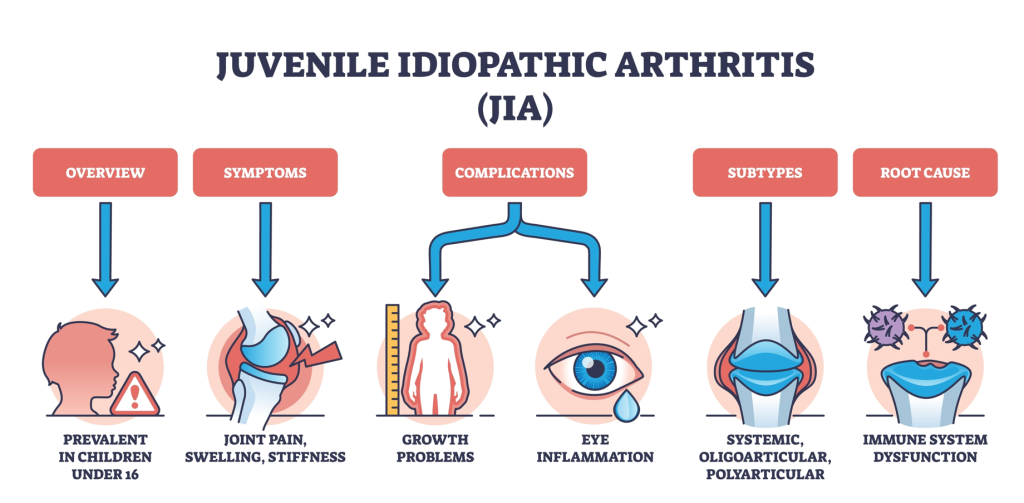
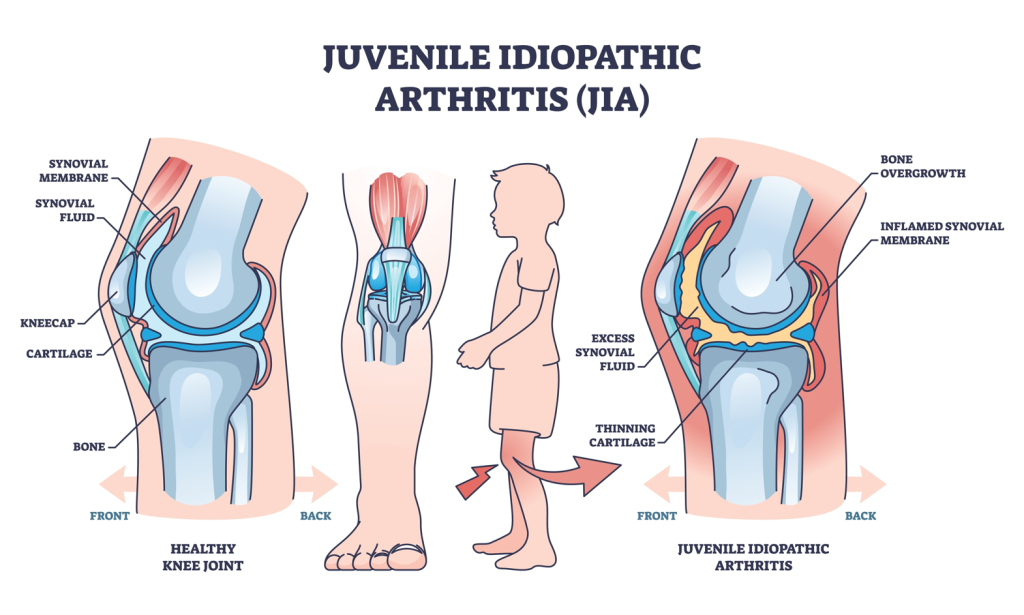
The goal is inactive disease: no swollen joints, no active inflammation on exam or labs, and no symptoms that limit what a child can do. That is a higher bar than “the pain is better,” and it exists for a reason. Inflammation that continues at a low level can quietly damage cartilage and bone, affect how a joint grows, and in some types of JIA, affect the eyes or internal organs.
This is why the approach to treating JIA has shifted. The American College of Rheumatology’s most recent guidelines emphasize moving to disease-modifying treatment sooner and relying less on medications that only address symptoms. As one of the guideline authors put it when the update was released, pediatric rheumatologists now escalate disease-modifying treatment more rapidly than in the past.
What Medications Are Used to Treat Juvenile Arthritis?
Families usually encounter four categories of medication. Not every child needs all of them, and the order and combination depend on the type of JIA.
NSAIDs (nonsteroidal anti-inflammatory drugs). Medicines such as ibuprofen and naproxen reduce pain and stiffness. They are helpful for comfort, and they are often part of early treatment, but they do not change the underlying disease. Guidelines now recommend shorter courses, since NSAIDs taken for long periods can irritate the stomach and affect the kidneys.
Steroid joint injections. For a child with arthritis in one joint or a few joints, an injection of a long-acting corticosteroid directly into the joint is often strongly recommended as initial treatment. A single injection can calm a joint for months, sometimes longer, with very little of the medication reaching the rest of the body. Young children are usually given light sedation or a numbing agent so the procedure is not frightening.
Conventional DMARDs, usually methotrexate. DMARD stands for disease-modifying antirheumatic drug. Methotrexate is the one used most often in children, and it has been the backbone of JIA treatment for more than 30 years. It is given once a week, as a liquid or tablet by mouth or as a small injection under the skin, and it works by dialing down the immune activity that drives joint inflammation. It takes six to twelve weeks to reach full effect, so patience in the first few months is part of the process.
Biologics. These are newer medications made from proteins that block specific signals the immune system uses to create inflammation. Different biologics target different signals: TNF inhibitors such as adalimumab and etanercept are common for arthritis affecting the joints, while IL-1 and IL-6 inhibitors are the preferred first-line treatment for systemic JIA, the type that causes fevers and rash. Biologics are given by injection at home or by infusion in a clinic. They are typically added when methotrexate alone is not enough, or used first in situations where guidelines support it.
Oral steroids. Prednisone and similar medicines reduce inflammation quickly, which makes them useful for severe flares or while waiting for a slower medication to take effect. Current guidelines recommend against relying on them as a long-term treatment because of their effects on growth, bone density, weight, and mood in children. When they are needed, the aim is the lowest dose for the shortest time.
Is Methotrexate Safe for Children?
This is the question parents ask most, and it deserves a direct answer. Methotrexate is used at much lower doses for arthritis than for cancer, and its safety record in children with JIA is well studied. A meta-analysis of 26 studies covering nearly 4,000 patient-years of treatment found that the most common side effects were mild, mostly nausea and temporary elevations in liver enzymes, that serious adverse events occurred in roughly 1 in 200 patients per year of treatment, and that more than two-thirds of children had no side effects at all over a year.
In practice, the side effects families notice are nausea on the day of the dose, fatigue, and occasionally mouth sores. Several things help: taking the dose at bedtime, taking a daily folic acid supplement, which is standard, and switching from oral to injectable methotrexate, which often reduces nausea. Regular blood tests check liver function and blood counts, and at Cure 4 The Kids Foundation those labs are drawn on site, usually at the same visit.
Anyone receiving methotrexate should avoid alcohol, and the medication is not safe during pregnancy. Your rheumatologist will raise it at the appropriate time.
What Are Biologics, and How Are They Given?
Biologics have changed what is possible for children with JIA. Before they became available, children whose arthritis did not respond to methotrexate had few good options. Today, a child whose disease is not controlled on one medication has several more to try.
How a biologic is given depends on the drug. Some are injected under the skin at home, every week or every other week, using a prefilled pen similar to an insulin pen. Others are given by intravenous infusion, which takes one to several hours and is repeated every few weeks. C4K has an on-site infusion suite designed for children, so families receiving infusion-based medications do not need to go to a hospital or a separate infusion center for each dose.
Because biologics and methotrexate work by reducing immune activity, children taking them are somewhat more likely to catch infections and may take longer to clear them. The practical rules are simple: call the care team about fevers, keep up with routine vaccines, and let the team know before any planned surgery or dental procedure, since medications are sometimes paused briefly around those events.

Can My Child Get Vaccines While on Treatment?
Yes, with one category of exception. The ACR guidelines strongly recommend routine vaccinations for children with JIA, and the evidence does not support the common worry that vaccines trigger flares. Annual flu shots are encouraged. The European pediatric rheumatology vaccination recommendations, updated in 2021, reach the same conclusion: non-live vaccines are safe during immunosuppressive treatment and generally still work, though the response may be weaker during high-dose steroid treatment.
The exception is live vaccines, such as MMR and varicella (chickenpox), which are generally avoided while a child is immunosuppressed. Whenever possible, rheumatologists try to bring a child’s live vaccines up to date before starting methotrexate or a biologic. If that is not possible because treatment cannot wait, the team will map out a plan. Bring your child’s immunization record to the first rheumatology visit so this can be sorted out early.
Why Does My Child with Arthritis Need Regular Eye Exams?
Uveitis, inflammation of the middle layer of the eye, affects a meaningful share of children with JIA, most often those with the oligoarticular type, those diagnosed at a young age, and those whose blood tests show a positive ANA. The reason it requires a dedicated screening schedule is that in children it is usually silent. There is often no redness, pain, or obvious vision change until damage has already occurred. Left untreated, uveitis can cause cataracts, glaucoma, and permanent vision loss.
The 2019 ACR/Arthritis Foundation guideline on JIA-associated uveitis recommends regular exams with an ophthalmologist using a slit lamp, with the frequency set by the child’s risk level. Children at highest risk are seen as often as every three months. When uveitis is found, treatment starts with steroid eye drops, and if the inflammation does not settle within about three months, methotrexate or a TNF inhibitor such as adalimumab is added. Many children with uveitis are already on one of those medications for their arthritis, which is one reason good control of the joints and the eyes tends to go together.
Our rheumatology team coordinates ophthalmology referrals and keeps track of the screening schedule, so families have one person to call when a question comes up.

What Else is Part of Treatment Besides Medication?
Medication controls the inflammation, but a child with arthritis also needs to keep moving, keep up in school, and feel like a kid. The ACR guidelines specifically recommend physical and occupational therapy to maintain range of motion and strength, prevent injury, and support every day and recreational activity. Rest is appropriate during a flare, but prolonged inactivity makes stiffness worse, and most children with well-controlled JIA can participate in sports and play with few limits.
How Long Will My Child Need Treatment?
There is no single answer, and your rheumatologist will be honest about that. JIA is a chronic condition, and some children need treatment through adolescence and into adulthood. Others reach inactive disease and stay there, and after a sustained period of remission on medication, typically a year or more, the care team may begin tapering. Current guidelines support reducing and stopping steroids once disease is inactive and, more cautiously, tapering biologics as well.
Tapering is done gradually, with monitoring, because arthritis can return when medication is reduced. That is not a failure; it is information, and it usually means restarting the medication that worked. The important thing is that stopping treatment is a decision made with the rheumatologist, never on a family’s own because a child seems fine. Inactive disease on medication and inactive disease off medication are two different things, and only the second one is confirmed by watching carefully after a taper.

What Should Families Expect From the Pediatric Rheumatology Program at C4K?
The Pediatric Rheumatology Program at Cure 4 The Kids Foundation is led by Dr. Luciana Paim Marques, one of just three pediatric rheumatologists currently practicing in Nevada, working alongside nurse practitioner Angela Berg and a dedicated rheumatology nurse who handles coordination and monitoring between visits. The program treats JIA along with childhood lupus, dermatomyositis, vasculitis, scleroderma, autoinflammatory syndromes, and other connective tissue diseases.
Everything described in this post is available in one place: steroid joint injections in a child-focused setting, on-site labs, the infusion suite for IV medications, an on-site pharmacy for when a child’s situation calls for it, and more. Families are referred by their pediatrician or can contact C4K directly at (702) 732-1493.
Frequently Asked Questions About Juvenile Arthritis Treatment
Will my child grow out of juvenile arthritis?
Some children do reach lasting remission, and others have a condition that continues into adulthood. Early, consistent treatment gives the best chance of inactive disease and protects joints in the meantime.
Is methotrexate chemotherapy?
Methotrexate is used at much higher doses to treat some cancers. For arthritis it is used at a small fraction of that dose, once a week, and it has been studied extensively in children with JIA. The side effects at arthritis doses are usually mild.
Can my child play sports while being treated for JIA?
In most cases, yes, and activity is encouraged. Your rheumatologist and physical therapist can advise on any temporary limits during a flare or after a joint injection.
How often will my child need blood tests?
Children on methotrexate or biologics typically have labs every few months to monitor liver function, blood counts, and inflammation markers. At C4K these are drawn on site.
Are biologics safe for children?
Biologics have been used in children with JIA for more than 20 years and are well studied. The main risk is a higher chance of infection, which is managed through monitoring, prompt attention to fevers, and keeping vaccines current.
What happens if my child misses a dose?
Call the care team. For most JIA medications, a missed weekly dose is not an emergency, but the right way to handle it depends on the medication and how late the dose is.
Does my child need an eye exam if their eyes seem fine?
Yes. Uveitis in children with JIA usually has no symptoms until it has caused damage, which is exactly why screening exams are scheduled regardless of how the eyes look or feel.

About the Author: Annette Logan-Parker brings over 30 years of experience in pediatric oncology and rare disease to her role as Founder and Chief Advocacy & Innovation Officer at Cure 4 The Kids Foundation. She has dedicated her career to improving outcomes for children with cancer and rare diseases, including ensuring equitable access to cutting-edge treatments for all families.